Business Continuity Planning Begins Before the Emergency
Your Building Is Talking. Are You Listening?
When most people think of Business Continuity they think of Emergency Actions, Crisis Communications and Disaster Recovery. These are all a response to problems with the facilities that businesses operate from every day.
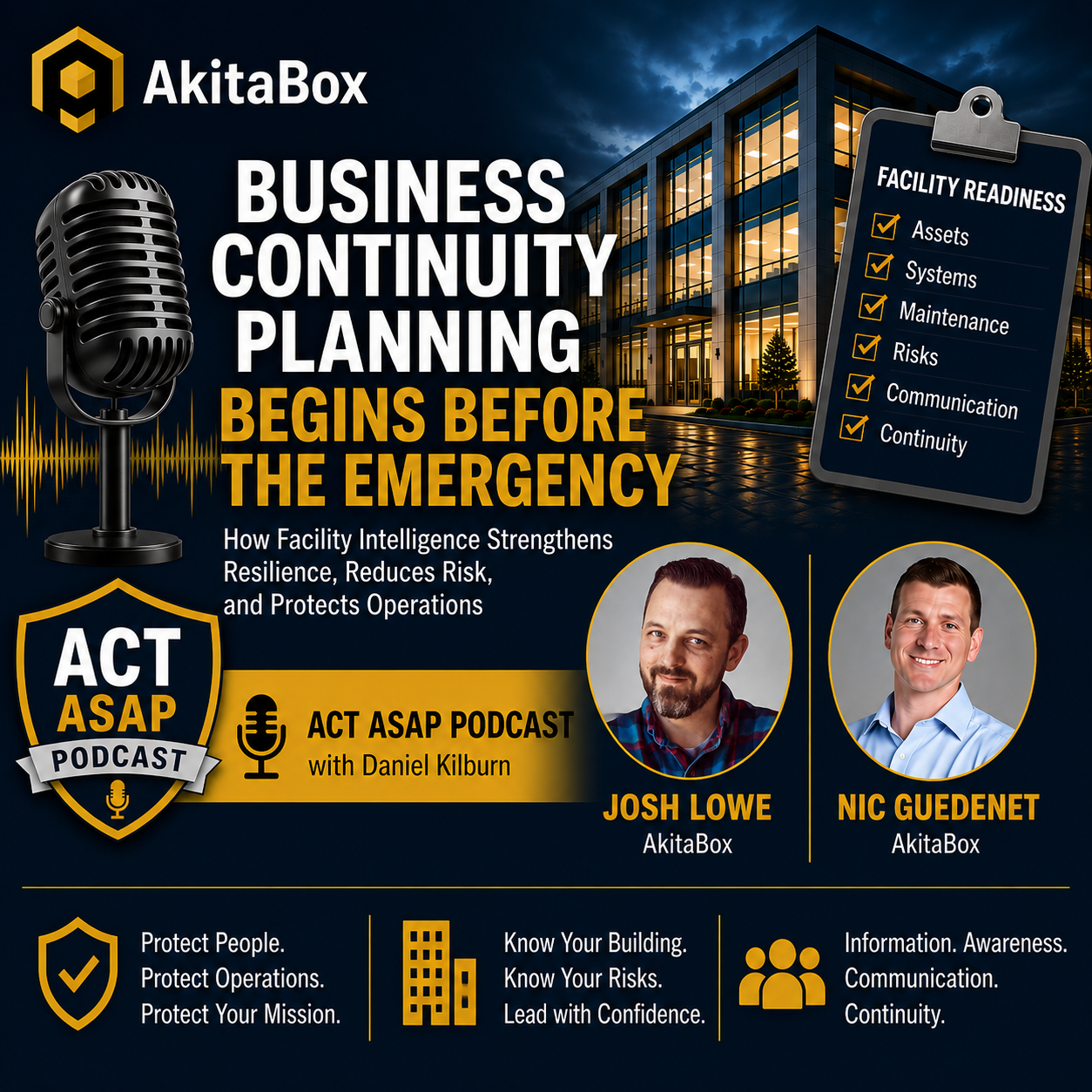
I recently spoke with Josh Lowe and Nic Guedenet of AkitaBox on the ACT ASAP Podcast about facility management and Business Continuity (BC) events. What I expected to be a conversation around various types of plans and processes for dealing with BC events actually turned out to be a discussion about Leadership and how preparing an organization for Business Continuity starts well before an incident actually occurs.
When the disruption happens, people don’t follow a set of binders… they follow the leaders.
Most Business Continuity Plans begin long before a disaster or other critical incident occurs. Such plans involve leaders becoming familiar with a number of items that could potentially impact business, including the organization’s facilities, critical systems and employees.
A decision made daily by many leaders is building maintenance, and budgeting for facilities. This can either add risk to an organization or decrease risk of future disruptions to normal business activities.
Building out a preparedness plan does not have to look like amassing a large library of binders to store on a shelf somewhere. The written plan exists to create an organization that is ready to respond in the face of a disaster before it actually occurs.
The Hidden Risk Most Leaders Never See

I asked Josh Lowe and Nic Guedenet of AkitaBox to elaborate on why business leaders should care about the physical building that they lease or own.
Their answer was simple.
Most organizations only think about the systems in their building when something fails. At that point, leaders are no longer leading; they are reacting to a crisis. A good reserve fund can pay for the repairs after the failure but that does not prevent the operational disruption in the first place.
Business continuity planning tries to avoid those types of failures in the first place. By identifying potential problems and developing a plan to deal with them before they occur and become a major continuity issue.
Think of ways that ordinary maintenance issues in a building could become a continuity of operations (COOP) event.
- A failed HVAC system closes an office during a heat wave.
- An electrical failure stops production.
- A roof leak damages critical equipment.
- Several maintenance issues combined to force the school to close classrooms.
These problems rarely begin as disasters.
These kinds of continuity events can start out as routine maintenance problems that organizations put on the back burner, and overlook as potential risks.
Prepared organizations are not just able to recover from any type of disruption, but are also working to prevent any number of such events from becoming a disaster in the first place.
A Building Holds More Than Equipment

Josh did a great job of illustrating one of the examples that we want to help leaders recognize regarding organizational risks in the ordinary maintenance issues of your building.
A retired facility manager for a particular organization was receiving calls for advice and consultation almost a year after he had retired from the organization. The hidden electrical outlet in the roof space of the building was fed by a single cord that powered the roof’s drain heat tape. The building was still standing. The man’s knowledge was slowly disappearing.
The building was still there.
The knowledge was disappearing.
Every organization has similar examples.
Someone knows:
- where the hidden shutoff valve is located,
- which breaker panel is mislabeled,
- why one room floods after heavy rain,
- or which HVAC unit serves the server room.
And, when that person leaves, whether it is for good or for a lengthy leave of absence, that knowledge is lost. More than just a very experienced employee has left the organization. The organization has lost its increased resilience as a result of that person’s knowledge loss. Preserving the institutional knowledge of the organization is as important as preserving the physical assets of the organization. Both must be maintained in order to prevent loss.
Therefore, preserving institutional knowledge is as important as preserving the physical assets of a building.
Deferred Maintenance Is Really Deferred Risk

Deferred maintenance equals deferred risk.
All systems of a building such as Heating, Ventilation & Air-Conditioning (HVAC), plumbing and electrical etc. are designed to last for a number of years before they start to deteriorate and eventually fail.
Deferred maintenance, or any other aspect of work in a building, that is put off in order to save money in the short term will only serve to place an organization in a position of extreme financial liability in the long term. All maintenance issues can and will affect a building in some negative way, and when they are allowed to fail completely they cause unforeseen catastrophic failures that are extremely expensive to recover from.
I often ask the audiences if they put on their seatbelt when they came to an event. Because after an accident has occurred, it is too late to put on a seatbelt. The same is true for business continuity planning, it always costs less to be prepared for a disaster rather than recovering from one.
You Can’t Protect What You Don’t Know Exists
One of the most important lessons that I have learned from my military service. One summer I was assigned to Cadet Command at Fort Knox, KY. Acting as a Platoon Sergeant of ROTC cadets we were conducting Drill & Ceremonies training. I had the platoon marching in a small grassy field adjacent to our barracks, when I noticed a stream of water rising from underground. The water had a horrible smell of feces. I quickly moved the cadets to an alternate location to continue their training and brought the situation to the attention of our Company First Sergeant.
It turned out that the reason for the water and smell was that the buildings had been closed for 9 months, and the feces that had been left in the drainage system had dried. With the buildings now being used by thousands of new individuals the drainage system was clogged, and the below ground pipes were failing and leaking sewage.
That experience taught me a simple lesson:
You can’t protect what you don’t know exists.
The same is true in every organization.
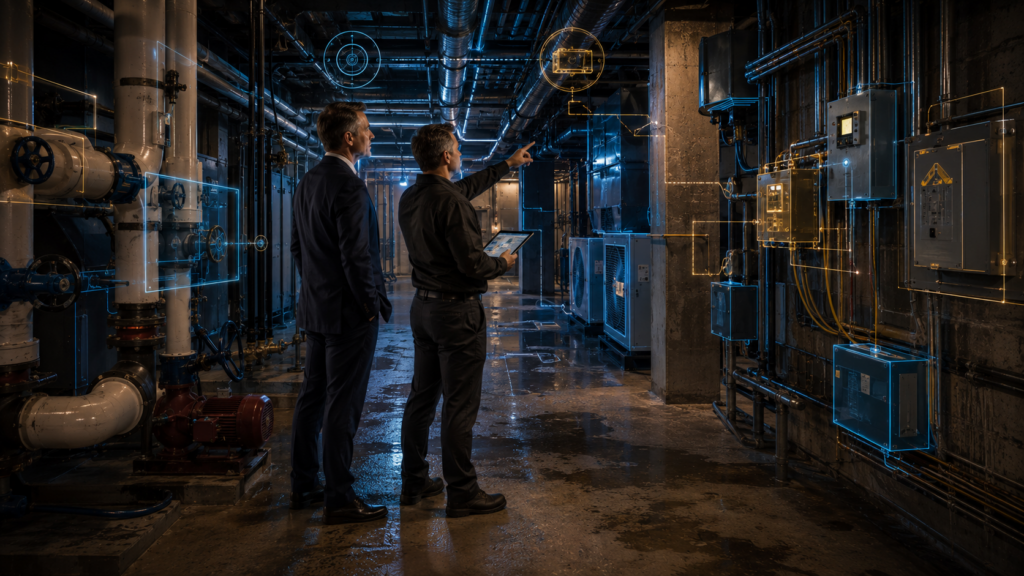
If leaders are unaware of the systems that support a facility and where the critical infrastructure resides, then they are operating in the dark, and are forced to make the best decisions that they can based on the information that they have been given.
Business continuity planning begins with awareness.
Technology Supports Leadership It Doesn’t Replace It

Artificial intelligence and digital facility platforms are revolutionizing how organizations manage their real estate and facilities. It does not matter how long a facility manager has been managing facilities, technology will play an increasingly important role as time goes on.
Technology is only as good as the information that has been put behind it. Good technology organizes information. Great leadership uses that information to make better and timely decisions.
Technology doesn’t replace people.
It equips leaders to lead more effectively.
Communication Is the Bridge Between Information and Action
Your knowledge has to come out of your head to have value.
Josh and Nic also explained that their technology also has a number of benefits including the ability to store all of the information of staff with many years of experience and allow other people in the organization to access that information.
I’ve often said:
Plans don’t communicate. People do.
Communication prior to a disruption is far greater to an organization’s ability to bounce back when faced with a crisis than communication during the actual event.
Preparedness Is Leadership
Before we concluded our conversation, I asked Nic & Josh, what do you ask a facility owner about what’s the first thing they should do when they get home or back to the office to make a decision whether they want to work with you? His answer was immediate:
“Ask yourself: Do you really know what you have in your building?”
That’s more than a facilities question.
It’s a leadership question.
Preparedness is knowing the risks to your organization, protecting critical assets, and having a means to preserve knowledge to continue to operate in the face of a disaster.
A Building Doesn’t Create Resilience, Leaders Do
The most interesting part of our conversation around business continuity planning was actually about leadership.
The technology discussed in this segment is not new. Josh and Nic outline the main points regarding preparedness and building a resilient organization.
- Awareness
- Communication
- Preparation
- Better decision-making
Technology supports resilience.
Leaders create it.
Business continuity planning is most successful as an ingrained part of the organization’s culture and not as an annual event that everyone feels is forced upon them.

The Leadership Challenge
Every organization has vulnerabilities.
The question isn’t whether disruption will occur.
The question is whether you’ll be ready when it does.
Instead of asking,
“What will we do if something breaks?”
Ask,
“What can I do today, to prevent it from breaking?”
This simple shift in focus from planning for potential disasters to fostering a culture of preparedness within an organization, transforms the business continuity planning from a set of documents to a leadership discipline.
Because when disruption comes…
People don’t follow binders.
They follow leaders.
Learn more here: The Difference Between a Binder and a System
Preparedness Is Leadership
Till next time,
Stay Informed & Stay Safe

Daniel Kilburn
Founder · Emergency Action Planning
📘 For more information go to: https://whatstheplandan.com/book

P.S.
One of the main points from my book ‘Why Plans Don’t Prepare You’ is that in reality, true preparedness in an organization takes time to create a culture and consciousness prior to a disaster that is better to serve through, than to refer to a plan. In reality many companies focus on preparing for potential plant failures by stockpiling key spares however when the failure occurs the plan is not acted on due to lack of awareness, lack of past knowledge and lack of communication throughout the organization. I was therefore pleased to see Josh Lowe and Nic Guedenet’s focus on preparedness through awareness, preserving knowledge and cross functional communication.
Recommended External Links
AkitaBox
AkitaBox Disaster Management Article
https://home.akitabox.com/blog/4-phases-of-disaster-management/
FEMA Business Preparedness
https://www.ready.gov/business
CISA FEMA Continuity Plan Template and Instructions
https://www.cisa.gov/resources-tools/services/business-continuity-planning-suite
OSHA
NFPA
IFMA (International Facility Management Association)
Content Transparency Notice
This article was developed with the assistance of artificial intelligence and reviewed, edited, fact-checked, and approved by Daniel Kilburn. All opinions, conclusions, and recommendations reflect the author’s professional experience and judgment.