What 90+ Years of Life Can Teach Us About Leadership, Love, and Human Connection
Act ASAP Podcast with Jim Paulk
Some of the conversations I have on the show are ones that will stick with me after the recording has stopped.
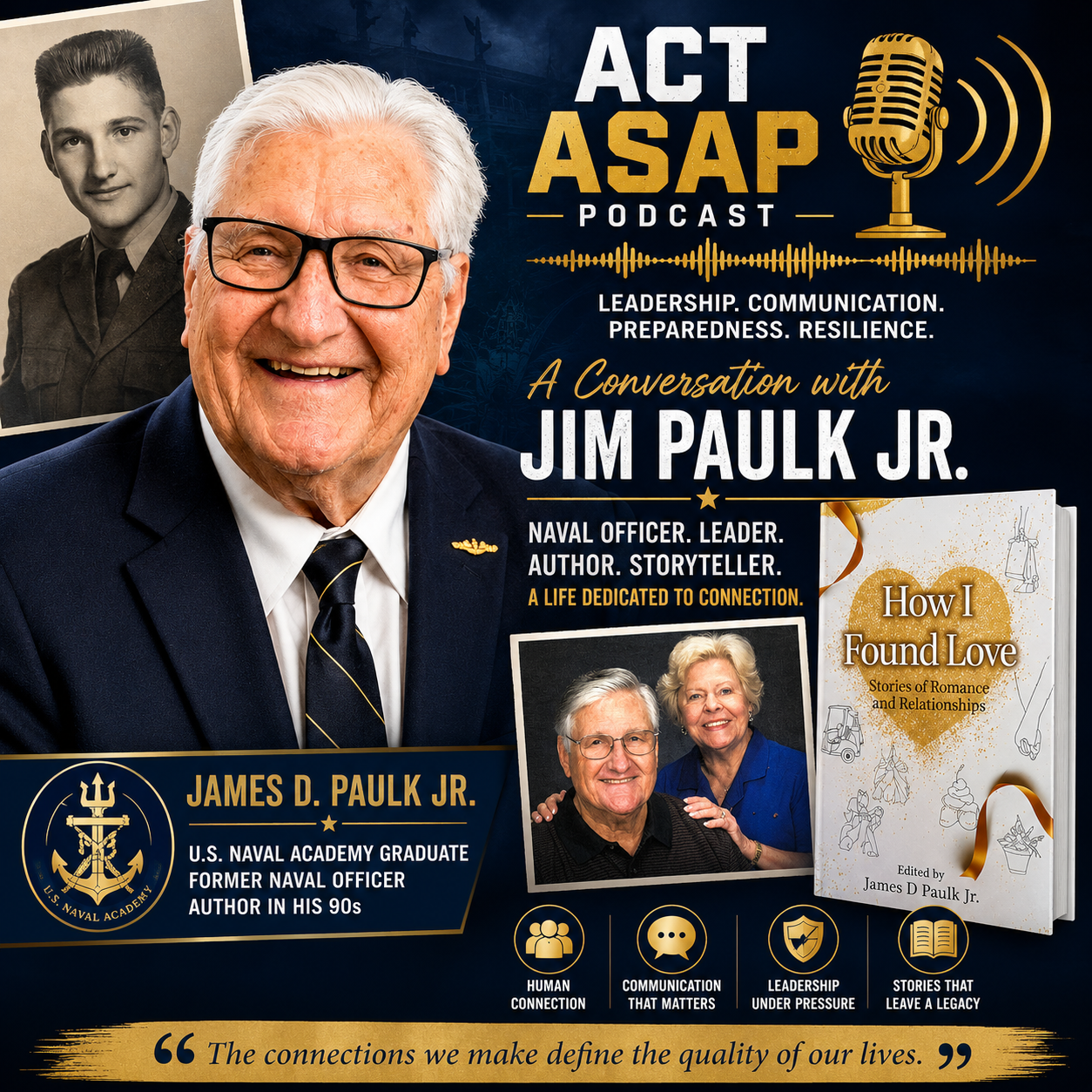
Recently, I had the opportunity to interview James “Jim” D. Paulk Jr. on the Act ASAP Podcast. Jim is a former U.S. Navy submarine officer, graduate of the United States Naval Academy, former manufacturing leader at Procter & Gamble, environmental conservationist, college instructor, author, storyteller, and lifelong student of human connection. What makes Jim’s journey especially remarkable is that he did not begin writing until his 80s. Now in his 90s, he continues to inspire and teach through storytelling, sharing the wisdom he has gained from decades of leadership, service, love, and life experience. Jim is living proof that our most meaningful work may begin long after we think our life’s primary work is finished. His story powerfully reminds us that purpose has no expiration date—and that relationships ultimately shape every other aspect of life.

Leadership Begins with Trust and Respect
One of the more powerful pieces of our conversation around leadership under pressure was when we discussed how strong families and marriages can assist civilian leaders – business, non-profit and community organizations – in leading during very difficult times.
So, for our listeners who are civilian leaders – whether they work for a company, whether they work for a non-profit, whether they work for a community organization, Jim Paulk’s definition of a strong family and marriage can translate very well to a strong team within any type of organization.
His answer was simple, but profound:
Trust and respect.
Jim went on to say that leaders cannot just rely on giving commands to their employees. They must make their employees feel trusted, respected and valued. He went on to say that when employees feel these things, they will do more than what is asked of them. They will go above and beyond for the leader and for the company. That struck me deeply.
In military environments, trust can mean life or death. In organizations, it can mean great performance, high morale, and an organization’s ability to handle disruption and adversity.
When disruption hits, employees do not suddenly become cohesive because a crisis plan exists.
They respond based on the culture that already exists.
They respond based on leadership.
Sound familiar?
This again supports one of the main points in my book, Why Plans Don’t Prepare You:
When disruption comes, people do not follow binders. They follow leadership.
Communication Is More Than Talking
Jim’s family describes him as someone who listens deeply, cares genuinely, and celebrates the stories of others.
His true nature was to listen deeply to others and to care about the things that mattered to them. He had a genuine love for others and was always
I asked Jim for his insights on the important lessons he learned from 90+ years of listening.
His perspective was refreshing.
Great communicators aren’t simply skilled speakers.
They are skilled listeners.
In a noisy, fast paced world, full of distractions and digital communications, listening to others has become a rare skill in today’s world of work.
Yet during crisis, listening becomes essential.
Leaders who fail to listen often miss:
- early warning signs
- employee concerns
- operational friction
- emotional distress
- communication breakdowns
Jim taught us how understanding people and how leading people are to understand them, and to slow down enough to hear them.
That is leadership.
Human Connection Is a Strategic Advantage
Modern society has never been more digitally connected.
And yet many people feel increasingly isolated.
That contradiction matters.
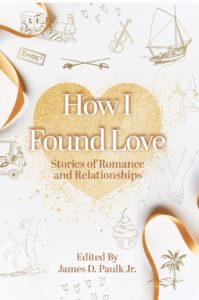
Jim’s newest book, How I Found Love: Stories of Romance and Relationships, explores how people have found love in truly unexpected ways. There are stories about blind dates, casual encounters, shared hardship, and even running into someone by chance while going about your daily routine.
This is not a fictional romance book.
It is a collection of authentic human stories.
- Stories of resilience.
- Stories of second chances.
- Stories of hope.
The deeper message?
Human connection rarely follows a plan.
And that’s exactly why it matters.
Most relationships, whether personal or professional, are built upon trust, present-ness, and vulnerability.
Not through perfect systems.
Storytelling Preserves Legacy
One of the best parts of our conversation about legacy, was the start of Jim’s sharing about his great-grandfather and the legacy that Jim has of him. Unfortunately
He knows almost nothing about him.
That reality led to one of Jim’s strongest recommendations for legacy:
Write it down. Save the story. Preserve the history.
That advice applies to families and organizations alike.
When stories disappear, wisdom disappears.
When institutional memory disappears, mistakes repeat.
And when the stories are not recorded the wisdom is lost. When the history of an organization is not written down the mistakes are repeated by future generations of leaders.
Storytelling is not just nostalgia.
- It is preservation.
- It is continuity.
- It is preparedness.
It Is Never Too Late
Perhaps the most inspiring lesson from Jim Paulk is…
It is never too late to begin.
- Not too late to write.
- Not too late to lead.
- Not too late to connect.
- Not too late to repair relationships.
- Not too late to leave a legacy.
Jim began publishing books in his 80s.
Let that sink in.
How many people are there writing off their life of work and doing meaningful things because of their age! They believe they are past their prime and can no longer do any good work for the rest of their life.
Purpose has no expiration date.
Jim Paulk’s Latest Book
Jim’s newest book is:
How I Found Love: Stories of Romance and Relationships
This heartfelt collection of authentic stories, humorous tales of adventure and of learning, follow the lives of people to discover their surprising finds of lasting love, whether they had given up hope of finding it, or found it when they least expected it.
These stories will touch your heart and perhaps give you new ideas for second chances.
Available now on Amazon: https://amzn.to/4vKAd1C.
How I Found Love – Amazon
 Final Thoughts
What in the world does a romance book have to do with being prepared and business continuity?
More than you might think.
Preparedness is not fundamentally about checklists.
It is about people.
- Plans matter.
- Processes matter.
- Technology matters.
But it is the less tangible elements that will determine how well you have done with your preparation when the ‘crisis’ hits.
Relationships.
Do people trust one another?
Can they communicate clearly?
Will they work together under stress?
Can leadership create calm amid uncertainty?
Jim Paulk’s life reinforces a truth I believe deeply:
Strong relationships create resilient people.
Resilient people build resilient families.
Resilient families build resilient organizations and communities.
That is why this conversation needs to be on the Act ASAP Podcast.
Additional Information: Testing Communication Systems
Stay informed & stay safe,

Daniel Kilburn
Author of Why Plans Don’t Prepare You
Host, Act ASAP Podcast
Founder, Emergency Action Planning
Postscript: How This Connects to Why Plans Don’t Prepare You
My book Why Plans Don’t Prepare You exposes the fallacy that having a plan written out will ensure you are ready for the unexpected.
They do not.
Readiness lives in people.

Another insight for the conversation that this post will explore in depth has been gained by Jim Paulk’s insights and understanding that the key element that prepares people for the unexpected is Love.
Love, trust, communication, loyalty and storytelling are all important to the human systems that a plan depends on to be carried out.
A plan may tell people what to do.
Relationships also play a part in people’s ability to implement a plan after everything has fallen apart.
That is the human side of preparedness.
And that may be the most important side of all.
This article was developed with the assistance of artificial intelligence and reviewed, edited, fact-checked, and approved by Daniel Kilburn. All opinions, conclusions, and recommendations reflect the author’s professional experience and judgment.
An AI likes to list, to summarize, to reiterate. An article touched by an AI can become like an ecumenical sermon the day after a football game, composed properly, occupying virtual space, puzzling. I asked directions of an AI yesterday 1) afternoon 2) unsolicited 3) out of the blue. It rewarded me with A. outstanding misinforrmation B. flattering encouragement C. an empty feeling of lostness. This morning I, a human, am using a new computer keyboard which was x. a gift y. without instructions z. called Qwerkywriter.
What is the thrust of this comment, puzzling, baffling, and fragmented as it is?