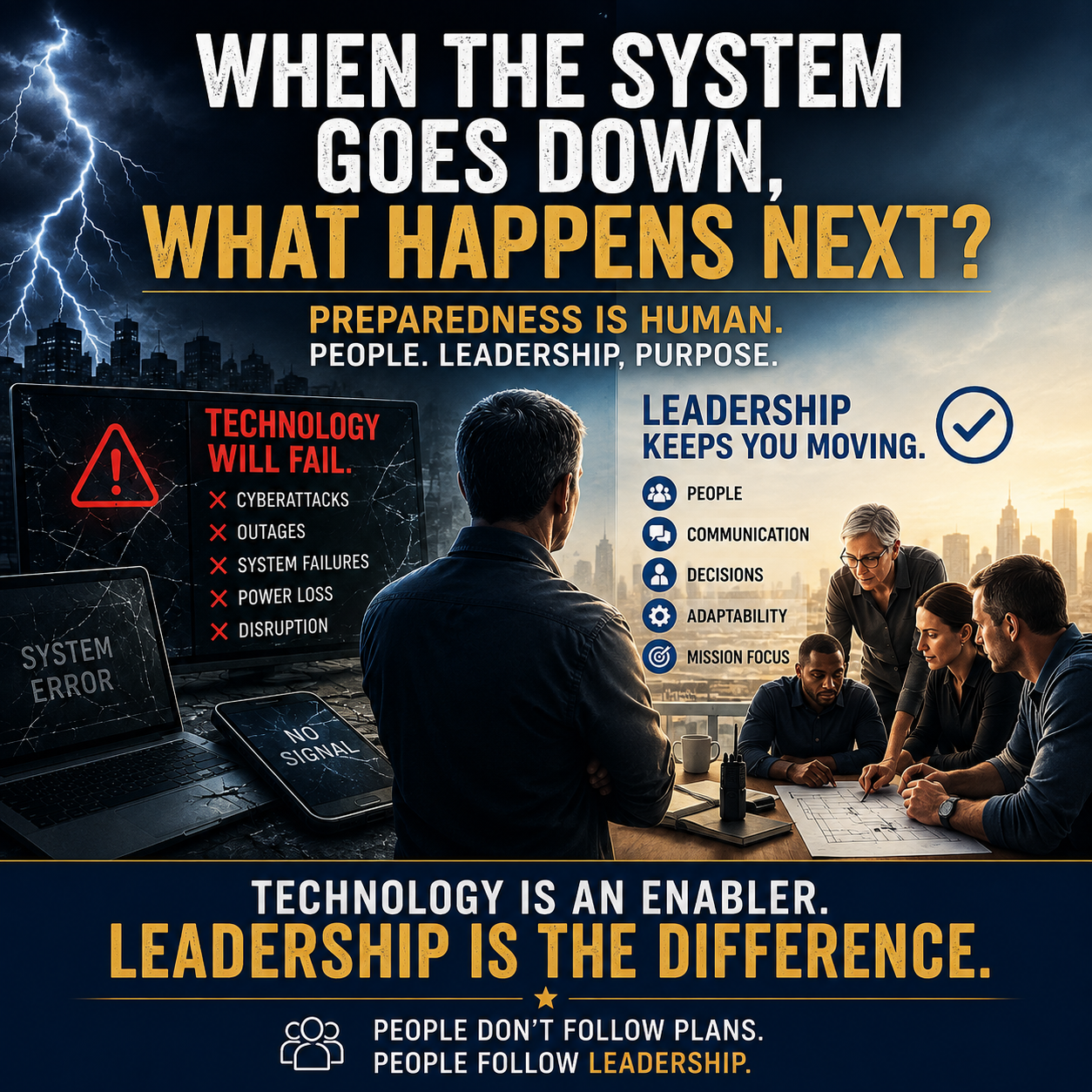
Preparedness Is Human: Why Your Biggest Continuity Risk Isn’t Technology, It’s Dependency
Business continuity leadership has become one of the defining challenges facing organizations today. Over the last several months we have watched technology failures expose just how dependent many businesses have become on digital systems to accomplish their mission.
This isn’t simply my opinion. The NIST Cybersecurity Framework emphasizes governance, risk management, and organizational preparedness as essential components of cyber resilience. Likewise, ISO 22301 defines business continuity as the capability to continue delivering products or services at acceptable levels during a disruption.
National Institute of Standards and Technology (NIST) – Cybersecurity Framework 2.0
ISO 22301 – Business Continuity Management Systems pdf.
A number of significant disruptions to technology have recently made headlines. Cyberattacks have taken down the production lines of manufacturers, the IT systems that manage the treatment and distribution of water for communities and municipalities, cloud services for thousands of organizations, the telecommunications systems that organizations use to communicate with each other and with external parties such as customers and suppliers, and so on. Outages of power and of transportation systems due to extreme heat and wildfires have already put organizations into continuity mode. The next question is: Can AI generate a very good business continuity plan. The question then is: Is it any good?!
At first glance, these different disaster scenarios seem to be totally unrelated to each other.
They’re not.
Every one of these examples are lessons for the single leadership lesson that technology will fail.
Technology doesn’t keep organizations operating.
People do.
It is a given that technology will fail.
The real question is this:
What if all the technology your organization normally uses to complete its work to cease functioning in the morning? Would your people be able to complete your organization’s mission without the technology used to complete work?
Business Continuity Leadership Begins with Technology, Not Dependence
Let’s be clear.
Technology is one of the greatest force multipliers that have ever existed in organizations.
Innovative technology today enables businesses to function at a faster pace and more efficiently than ever before. Whether it is to communicate with teams and other businesses instantly around the globe, automate time-consuming tasks, to gather and analyze data to monitor and track your business 24/7, process financial transactions instantly, and to collaborate with other teams and businesses, technology is a great way for businesses to function today.
Technology has created some of the greatest capability to add value to any organization that has ever existed. And businesses today are running faster, more efficiently and more connected than ever before.
None of that is the problem.
The problem begins when convenience quietly becomes dependency.
There is a big difference between utilizing technology to carry out an organization’s work, and being unable to function in the absence of technology.
Most organizations do not even know that they have become dependent upon technology until it is too late.

Business Continuity Leadership Requires Reducing Technology Dependency
The recent cyberattack on the milk processor Fairlife for all intents and purposes took their IT systems.
A cyberattack of the Fairlife manufacturing plant, where production was disrupted since the company was unable to access its digital systems supporting its business as usual.
Fairlife – https://fairlife.com/news/technology-disruption-fairlife-operations/
Additionally, a number of high-profile cloud service outages have impacted organizations that have placed a large portion of their business functions on a single cloud provider.
Telecommunications failures have brought home the point to many organizations recently of how they are dependent on a variety of different networks many of which are outside of their control.
Water system cyberattacks demonstrated something even more concerning.
A cyberattack doesn’t simply threaten computers.
A cyberattack on a community’s water system can cause physical disruption to the daily operations of a community for days, weeks, or even longer.
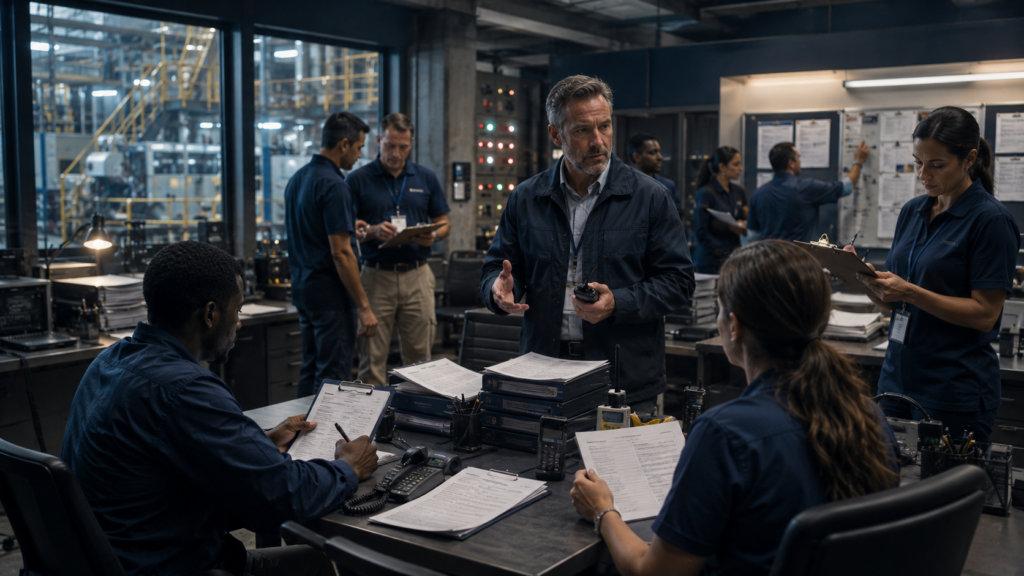
Then there’s artificial intelligence.
In seconds, AI can generate, for example, a continuity plan, an emergency management plan, a risk assessment or even a complete organization policy.
That’s impressive.
There is also a fallacy that technology such as AI can create documents that leaders believe will prepare them for the worst. The technology can create a very good document such as a continuity plan, emergency action plan, risk assessment and business policies in seconds. But creating a document is not the same as leadership producing readiness.
Technology can produce information.
Only leadership produces readiness.
Hasbro Demonstrated What Real Continuity Looks Like
One of the greatest stories of business continuity resilience this year is that of Hasbro.
Wall Street Journal – Hasbro’s Lessons From a Cyberattack
Toy manufacturer Hasbro was affected by a cyberattack that targeted major business systems including the enterprise software vendor SAP.
Employees continued working.
Why?
Because the organization had prepared people, not just systems.
Employees understood how to perform essential work manually.
Leaders continued making decisions.
Authority remained intact.
Communication continued.
The mission continued.
That’s what business continuity is supposed to accomplish.
Technology failed.
Leadership didn’t.

Business Continuity Leadership Is About People, Not Software
Business continuity is often misunderstood. Many assume it’s about writing plans. Others believe it’s about buying software.
Some think compliance equals preparedness. None of those assumptions are true. ISO 22301 defines business continuity as an organization’s ability to continue delivering products or services at acceptable predefined levels following a disruption.
ISO 22301 – Business Continuity Management Systems pdf.
Continuity has always been about one thing:
Helping people continue serving people despite disruption.
Technology may support your operation.
People are your operation.
A business without technology may operate more slowly.
A business without leadership stops.
Buying all the right technology to support your organization after a disaster will not keep your organization from being vulnerable to disaster.
Organizations that invest in people become resilient.

Five Business Continuity Leadership Questions Every Executive Should Ask
Five Questions Every Leader Should Ask Today: If you manage employees, customers, students, volunteers or a community then these 5 questions are for you.
- Could payroll continue if your primary systems became unavailable?
Employees still expect to be paid.
Would you know how?
- Could you communicate with your employees?
What would you do if email, Microsoft Teams, Slack, your phone system went down? How would you get a hold of all your employees?
- Could customers still reach you?
Would they know where to go?
Who would answer?
- Could leadership continue making decisions?
Every process for decision making will stall until your IT system is back online.
- Could you continue serving people manually?
Perhaps more slowly.
Perhaps less efficiently.
But could you still accomplish your mission?
If any of those answers make you uncomfortable, you’ve identified an opportunity to strengthen your organization before a disruption puts it to the test.
This article begins to answer five very important questions to prepare us for those as yet unseen circumstances.
AI Supports Business Continuity Leadership; It Doesn’t Replace It
I use artificial intelligence to support my work as a leader.
- It helps me organize information.
- It helps me analyze assessment results.
- It helps me identify trends and accelerate planning.
But AI does not replace experience.
- It does not replace judgment.
- It does not replace accountability.
And it certainly does not replace leadership.
The danger isn’t that AI produces bad answers.
The biggest danger in all of this is that leaders are going to buy answers that look good but have never been tested.
National Institute of Standards and Technology (NIST) – Cybersecurity Framework 2.0
Cybersecurity and Infrastructure Security Agency (CISA) – Cybersecurity Performance Goals
Preparedness isn’t created by generating documents.
Preparedness isn’t created by generating documents (or meeting agendas, or leader profiles) rather it is validated by seeing whether they actually work in times of disruption to business as usual.

The Business Continuity Leadership Lesson
Disruptions will continue.
Cyberattacks will continue.
Power failures will continue.
Natural disasters will continue.
Technology will continue evolving.
The organizations that thrive will be those whose people know how to adapt to changes in circumstances while staying focused on the organization’s mission and working together as a team to make good decisions in the midst of uncertainty.
FEMA – National Preparedness Goal
They will be the organizations where employees are clear on the organization’s mission, communicate effectively, make wise and informed decisions and are able to adapt to changing circumstances.
That’s why I’ve said for years:
People don’t follow plans.
People follow leadership.
Your Next Step
Preparedness isn’t about predicting the next disruption.
Preparedness for future disruptions does not have to mean trying to predict when the next cyberattack, power outage, natural disaster, or technological change will occur.
If you’re responsible for the safety of employees, customers, students, or your community, don’t wait until technology fails to determine if your organization is prepared.
Ask one simple question today:
Can we still accomplish our mission if our systems disappeared?
If you can’t answer yes with absolute certainty then you have found the most critical leadership conversation that your organization needs to have.
Because when the system goes down…
Leadership takes over.
Preparedness Is Leadership
Till next time, stay informed and stay safe

Daniel Kilburn
Founder – Emergency Action Planning
P.S. Every organization has blind spots. The challenge is discovering them before a cyberattack, power outage, natural disaster, or system failure exposes them for you.
If this article caused you to question whether your organization could continue operating without its technology, don’t ignore that instinct.
Start by reading Why Plans Don’t Prepare You, where I explore why people follow leadership, not binders. And what real preparedness looks like when disruption tests your organization.
Then, when you’re ready to move from awareness to action, complete the Start Independently – Business & Community Continuity Assessment. In about 14 days, you’ll receive a clear picture of your organization’s strengths, vulnerabilities, and practical next steps to improve resilience before the next disruption occurs.
Preparedness isn’t about predicting the future. It’s about building the leadership capacity to succeed no matter what the future brings.
Learn more:
📘 Book: https://whatstheplandan.com/book
📋 Business & Community Continuity Assessment: https://whatstheplandan.com/start
“When disruption comes, people don’t follow plans. They follow leadership.”
Additional Resources:
Wall Street Journal – Hasbro’s Lessons From a Cyberattack
Fairlife – Technology Disruption Updates
National Institute of Standards and Technology (NIST) – Cybersecurity Framework 2.0
Cybersecurity and Infrastructure Security Agency (CISA) – Cybersecurity Performance Goals
U.S. Environmental Protection Agency – Water Sector Cybersecurity
FEMA – National Preparedness Goal
ISO 22301 – Business Continuity Management Systems
This article was developed with the assistance of artificial intelligence and reviewed, edited, fact-checked, and approved by Daniel Kilburn. All opinions, conclusions, and recommendations reflect the author’s professional experience and judgment.