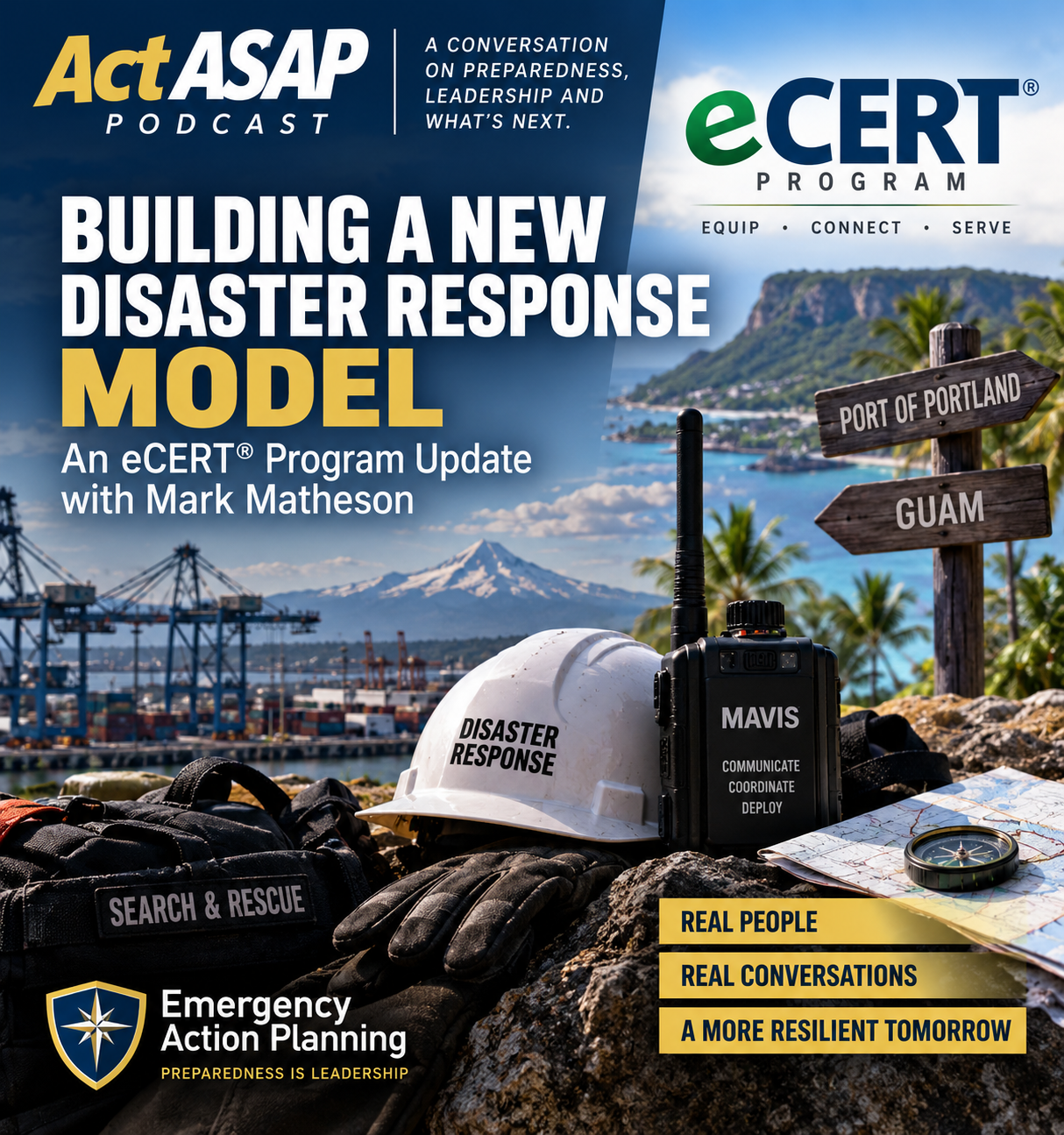
eCERT® Program Update with Mark Matheson
What would it actually take to build a national disaster response network (of independent organizations, specialized personnel, communications, and equipment) and keep them independent?
I posed this same question in my latest Act ASAP Podcast to Mark Matheson, founder of the developing eCERT® Program.
One of the most significant updates concerned infrastructure.
In this Act ASAP Podcast conversation, Daniel Kilburn speaks with Mark Matheson, founder of the developing eCERT® Program, about the program’s evolving model, communications capabilities, organizational participation, and disaster deployment.
Questions About the eCERT® Program?
For questions about the developing eCERT® Program or the topics discussed in this conversation:
Mark Matheson — Founder, eCERT® Program
Email: [email protected]
eCERT® Program
Daniel Kilburn — Emergency Action Planning
Email: [email protected]
Schedule a conversation with Daniel
A National Disaster Response Network Begins Before the Disaster
I had a chance to revisit my earlier Act ASAP Podcast conversations with Mark Matheson of the developing eCERT® Program. How can we transform currently existing capabilities into coordinating structures and processes in the hours after a disaster strikes?
He shared updates on a developing program service center for the eCERT(R) Program in Guam which will serve as a membership center and Program primary point of contact. Additionally, the plans for the eCERT(R) Program service center in La Pine, Oregon were discontinued and they have refocused efforts to develop a manufacturing plan at the Port of Portland.
The above details bring some insight into this development, but there is a much greater and highly relevant lesson here for leaders.
In the disasters to come, the ability to respond will not be established by the helpful response of capable people and resources after the disaster has occurred. All of the necessary relationships, tools, equipment, means of communication, rules, training, and expectations must have been established before the disaster.
We talked about the same types of things when discussing preparation of organizations to support FEMA in disasters using the NIMS resource-management guidance. Identifying and typing resources, credentialing personnel, planning for use of resources, setting up the mechanisms to provide and receive mutual aid, etc. before they are actually needed.
Communications Could Be the Force Multiplier
What is the MAVIS concept?
The major point of this discussion on the Act ASAP Podcast is to describe the MAVIS unit.
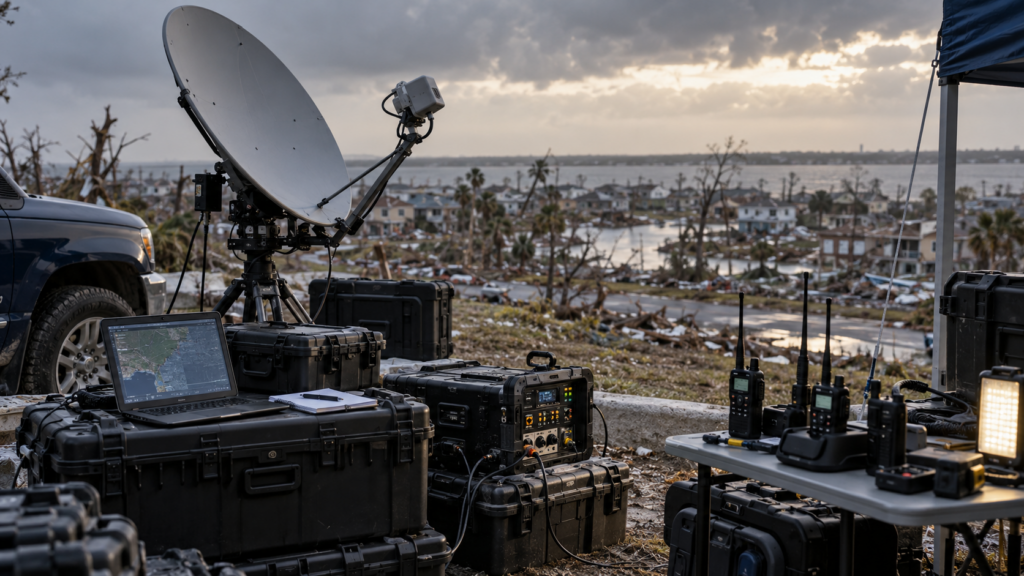
I discussed the MAVIS unit, which Mark referred to as an earth-station-style platform that would supply a community with satellite capability, phones, etc. when regular infrastructure wasn’t available. I said this would be a “communications multiplier” to support disaster relief efforts, and Mark related that the original technology was used to support the U.S. Forest Service in previous years. He said that with the eCERT® concept, the service would be delivered to a far greater geographic area.
The MAVIS Unit is a communications multiplier as it enables capable people to go where needed and provide service in the face of disasters.
Capable people on the scene don’t do much good unless they can also communicate, coordinate, receive instructions, and be managed by others on the scene as part of a larger operation.
Matching capability to the incident
Mark’s vision isn’t for every participating organization to do everything.
This means that instead of trying to do everything as one massive organization, organizations maintain unique specialties and respond to disasters based on their area of expertise.
That distinction matters.
A National Disaster Response Network is useful only if each center knows not only who is available to respond to a disaster but also what that person’s expertise and equipment are intended to do.
Independence and Coordination Don’t Have to Be Opposites
One of the interesting aspects of the eCERT® concept for me has been the attempt to preserve organizational independence among the participating nonprofits.
So participating nonprofits in this vision would remain independent organizations – their own separate non-profits with their own mission and making their own organizational decisions. The proposed model would only have an oversight structure for logistics once an incident has occurred.
That’s a good concept but it presents some hard operational issues.
How do you preserve independence while establishing:
- Common operating expectations
- Credentialing and qualifications
- Activation authority
- Communications interoperability
- Liability and reimbursement mechanisms
- Resource tracking
- Command and coordination relationships
I agree that these are not abstract concepts. FEMA lists liability, compensation, reimbursement, credentialing, qualifications, mobilization, and other operational support issues and how these will be addressed by a nonprofit’s mutual aid agreement in FEMA’s current guidance for managing mutual aid.
From Available Volunteers to Deployable Capability
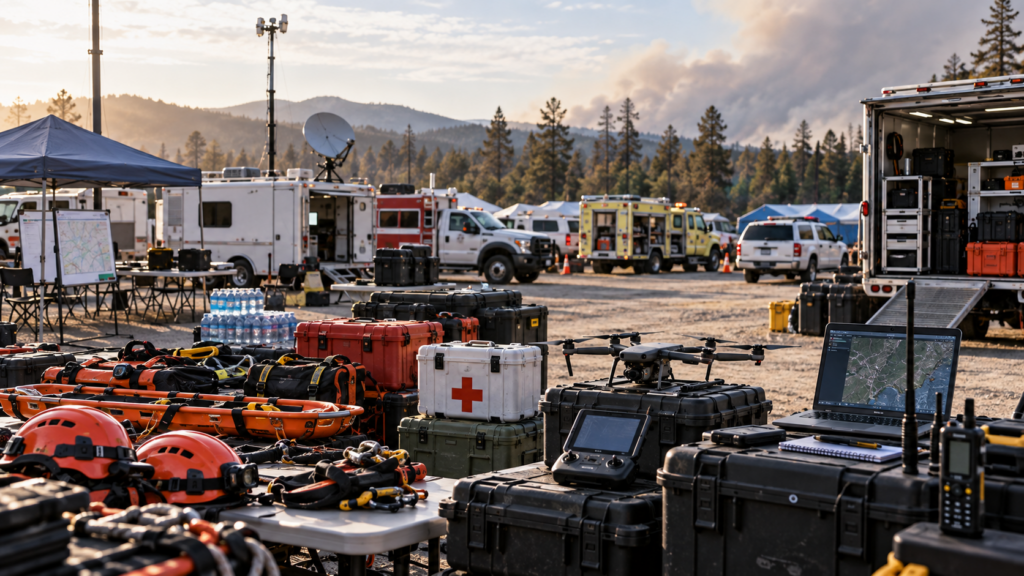
Additionally, a possible way for the different organizations to be deployed after an incident has occurred is through a call-out for volunteers after an incident has been declared. Volunteers would then decide whether or not to deploy and report at a predetermined location (rally point) with the necessary equipment. This is supposed to occur within 24 to 48 hours.
That raises another important distinction:
The existence of volunteers and trained personnel does not translate into having an effective and functional capability to respond and support incidents.
Training of volunteers, availability of required equipment, clarification of the scope of authority of deployed leaders, means of transportation, communication, logistics, credentials, compensation and integration with the overall incident response.
The current FEMA framework manages aspects of mobilization, tracking, reporting, demobilization, reimbursement and restocking of resources during an incident.
The eCERT® Program Is Still a Developing Model
It’s important to be clear about where this conversation sits.
It’s also important to recognize that a program is still being built and some of the concepts are going to be tested. Therefore, some of the things that Mark described in terms of having multiple MAVIS units at a community, we haven’t even tested yet to see how many we would actually need for a given incident.
Mark reiterates the point at the end of the conversation that the program is in development with lots of room for growth.
That’s why I believe these conversations matter.
The question remains; even after many hours of creative designing and organizing on paper. Will really work or not? And what assumptions have to be tested first.
The better questions are:
Will it work in the field? What assumptions need to be tested? What already exists that shouldn’t be duplicated? And what do experienced disaster-response leaders know that needs to be incorporated before the next step is taken?
Those are conversations worth having.
Capacity is what you can actually do when disruption hits.
It’s measured by what we’re actually prepared to do.
________________________________________
Learn more about the developing eCERT® Program
For additional context on established national incident-management principles:
FEMA/USFA — NIMS Resource Management
https://www.usfa.fema.gov/a-z/nims/resource-management.html
FEMA/USFA — NIMS Mutual Aid
https://www.usfa.fema.gov/a-z/nims/mutual-aid.html
FEMA — National Resource Hub
https://preptoolkit.fema.gov/web/nims-toolkit/resource-management
________________________________________
Continue the Conversation
Have questions about the developing eCERT® Program or want to learn more about the concepts discussed in this interview?
Daniel Kilburn
Emergency Action Planning
[email protected]
Schedule a conversation with Daniel
Mark Matheson
Founder, eCERT® Program
[email protected]
Learn more about the eCERT® Program
Preparedness Is Leadership
Till next time,
Stay Informed & Stay Safe
Daniel Kilburn
Founder · Emergency Action Planning
📘 For more information go to:
Why Plans Don’t Prepare You
Postscript
There is a cultural issue underneath this conversation that extends far beyond eCERT®.
Organizations can become comfortable believing that possessing a plan. Having trained people. Owning equipment, or belonging to a response system means they are prepared. Yet real readiness depends on what happens when those pieces must function together under pressure.
That’s one of the central ideas behind my book, Why Plans Don’t Prepare You. A plan can document what should happen. Leadership creates the culture in which people understand their authority, communicate, adapt, and act when reality doesn’t follow the plan.
Whether we’re talking about a family, business, nonprofit, or a developing national disaster response network, the principle remains the same:
The plan matters. The capability to execute it matters more.

Content Transparency Notice
This article was developed with the assistance of artificial intelligence and reviewed, edited, fact-checked, and approved by Daniel Kilburn. All opinions, conclusions, and recommendations reflect the author’s professional experience and judgment.