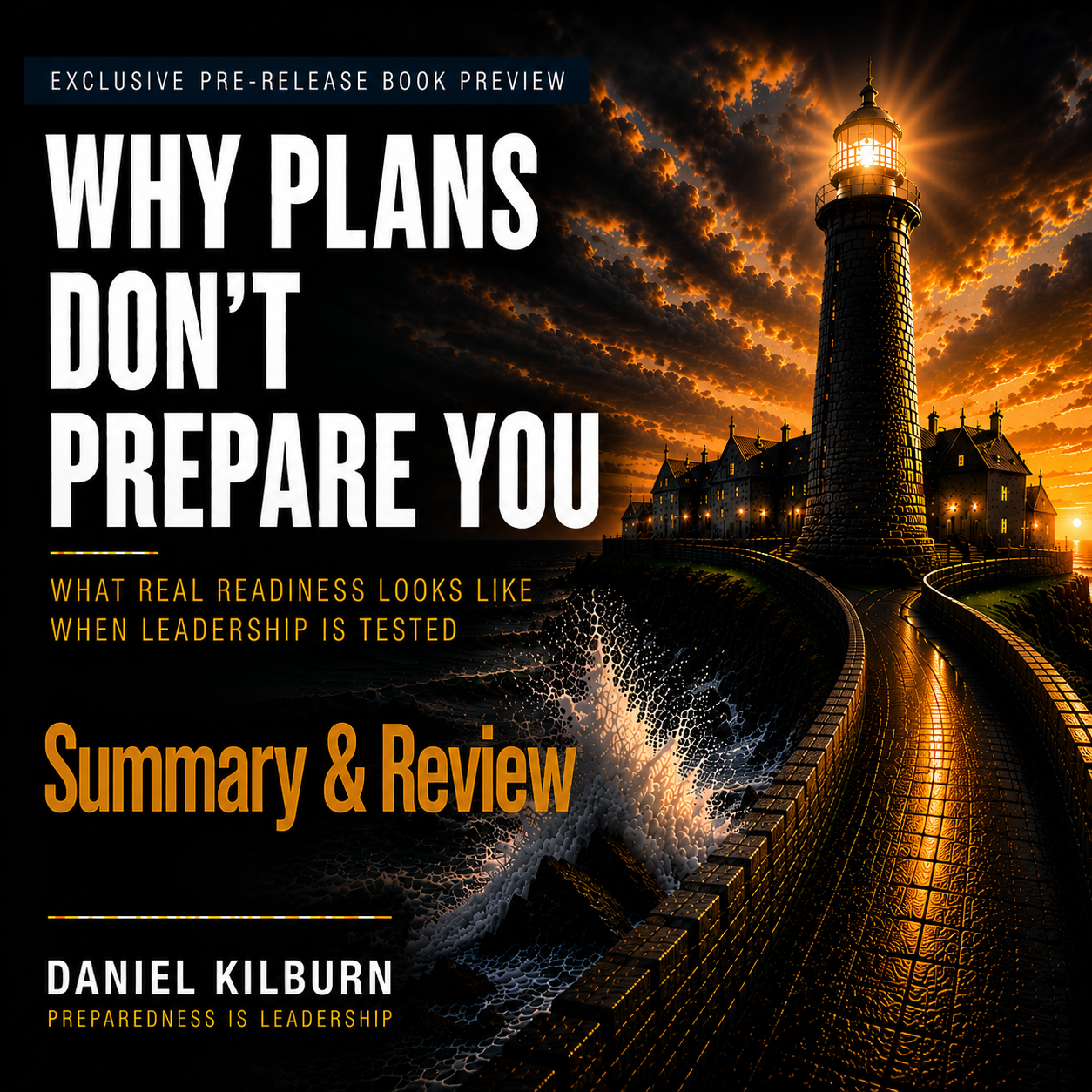
Why Plans Don’t Prepare You | Summary & Review
Why Plans Don’t Prepare You Summary: The Real Lesson Behind Readiness
My book, “Why Plans Don’t Prepare You: What Real Readiness Looks Like When Leadership Is Tested”, officially launched on Amazon (Monday the 1st) and so this seems like a good time to actually publish the summary and review of the main lessons of the book that I have been slowly posting online for the last few weeks.
The central message is simple:
Plans are important.
However, plans alone do not create readiness.
A plan is important. But in the end, plans are just documents. These can be detailed and include many checklists and procedures. But in the end, all of these do not equal clear thinking, decisive leadership, practiced systems of work, and a culture of readiness. The book Why Plans Don’t Prepare You explains that in the end, all of these things equal one thing: leadership. And this is the foundation of preparedness.
Real preparedness begins long before disruption occurs.
Leadership Readiness Review: Beyond the Illusion of Preparedness
Most companies think they are prepared for anything because they have a large plan and many rules. However, when the unexpected occurs, it quickly becomes apparent that they are not as prepared as they thought they were.
This book deals with the ‘illusion of preparedness’ and how written plans can satisfy a requirement but do not automatically create capability to deal with changes in conditions.
Even if a written plan fulfills all the requirements for a plan (which in itself does not automatically guarantee the ability to deal with unexpected changes), the extent to which team members have been informed about their tasks, which processes have been trained, and what communication routes have been set up and tested only becomes apparent when conditions change quickly.
There is a significant difference between written processes and prepared organizations. Prepared organizations have ready leaders. They are capable to deal with unexpected events. In crisis situations, such leaders are able to make the right decisions in split seconds. In addition, they are also able to ensure that things will keep running smoothly when they are not around any more.
Being ready for a disaster or other unexpected event gives your organization the ability to create ownership, accountability, and confidence with regards to tackling the situation in the best possible way.
Resilience Leadership Lessons From the S.T.A.R.T. Framework
What stands out in this book is that preparing for something is an ongoing process, not a single event.
Prepared leaders establish direction.
- They set goals
- They take action.
- They assess progress.
- They remain resilient.
- Then they transform and thrive.
And finally, prepared leaders concentrate on taking real steps that create progress gradually, rather than waiting for everything to be just right before they start to try to become more prepared.
They concentrate on taking real steps.
- Updating contact information.
- Testing communication systems.
- Clarifying leadership succession.
- Conducting tabletop exercises.
- Reviewing mission-critical functions.
Small steps of progress to create more resilience than an idle shelf full of great plans.
Continuity Planning Review: Systems Over Binders
Much of what has been written on the topics of emergency preparedness and business continuity is stored on bookshelves in binders.
A binder may contain valuable information.
A system creates capability.
- Systems are current.
- Systems are understood.
- Systems are owned.
- Systems are practiced.
- Systems are tested.
Most people do not actually go back to the plans that they had developed in advance of a crisis. Instead, they work with the capabilities and habits that they have developed while developing the binders.
Continuity planning is best spent building capability as opposed to making a bunch of documentation.
Building a Culture of Preparedness
Preparedness is not a project.
Preparedness is a culture.
High performing organizations during a disruption are performing because they have practiced readiness as part of their normal ongoing leadership. They regularly review and discuss potential risks, test their assumptions, identify points of potential vulnerability, develop robust communication pathways and ask better questions than less performing organizations. The key to improved performance is gaining experience and then learning from what worked well and did not.
Your family too will benefit from having Preparedness as a natural part of your daily life – instead of only hearing about disasters in the news and then reacting to them.
Culture develops through consistency.
- Not motivation.
- Not fear.
- Not occasional bursts of activity.
Consistent leadership creates a culture of readiness.
Calm, Confident Continuity in Times of Uncertainty
Staying calm and confident in times of uncertainty and crisis is not something that usually happens by accident. It is developed beforehand.
It is created beforehand.
Steady leadership builds trust.
Clear communication reduces uncertainty.
Practiced systems improve decision-making.
Organizations become more able to deal with disruptions and recover quickly to maintain their vital functions.
Preparedness is not about trying to anticipate and prepare for every possible event. It is about developing the
It is about developing the capability to respond in the best way possible to deal with any given challenge.
What Comes Next?
I did a quick scan of The Chapters that we have read so far – leadership, resilience, communication, continuity and preparedness.
Now the question becomes:
What is your next move?
- Perhaps your next step is identifying your top risks.
- Perhaps it is reviewing your communication systems.
- Perhaps it is conducting a tabletop exercise.
- Perhaps it is taking a readiness assessment.
Whatever that step may be, take it.
Progress matters more than perfection.
Action matters more than intention.
Leadership begins before disruption arrives.
Final Thoughts on Real Readiness
Reading Why Plans Don’t Prepare You will hopefully enable you to begin your journey to preparedness. It will hopefully enable you to begin to be a prepared leader, for preparedness is leadership.
Preparedness is leadership.
Leadership is not measured when conditions are easy.
Leadership is revealed when circumstances change, information is incomplete, and people are looking for direction.
Those moments reveal to us whether or not we have been cultivating readiness all along or if we have just been operating under an assumption that we are ready for situations like this.
My intention with “Why Plans Don’t Prepare You” is to make leaders more aware of the misconceptions they hold with respect to their preparedness, and to inspire action to increase their preparedness for the unexpected. Instead of being uncertain or confusing preparedness with confidence, leaders should strive to be truly ready for the unexpected.
Because when leadership is tested, preparation is no longer about the plan.
It is about the people, systems and decisions behind the plan.
________________________________________
Previous Chapter: Start Here: Your Readiness Path
Return to the main series hub page: Introduction
________________________________________
Till next time
Stay Informed & Stay Safe

Daniel Kilburn
Founder · Emergency Action Planning
P.S. Thank you for joining me throughout this chapter-reading journey.
What began as a book project became an opportunity to discuss leadership, resilience, preparedness, and continuity with readers and listeners around the world.
To celebrate the launch of Why Plans Don’t Prepare You, I am announcing a special Leadership Readiness Bonus for readers who purchase the book and are ready to take the next step in strengthening their preparedness.
More details are available at: whatstheplandan.com/book

In the meantime, I encourage you to reflect on one simple question:
What is your next move?
Because readiness begins with action.
Preparedness Is Leadership
AI Content Disclaimer
This article may contain content developed with the assistance of artificial intelligence and reviewed, edited, and approved by Daniel Kilburn.