

Techno Babble: How Technology Was Supposed To Change Our Lives For The Better But Has Failed.
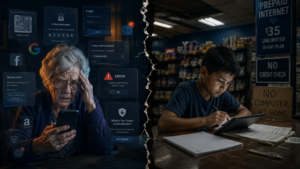
Technology Was Supposed to Make Life Easier
We are submerged in loads of technology which are supposed to help us in our daily lives, but actually create more trouble than it is worth. More and more applications, portals that require a login and password, QR-codes that have to be read with an application, AI chatbots that first of all need more information to help with a simple question, digital signatures, 2-factor authentication, and many more things, which together create a huge Techno Babble.
Most of all, however, this new Techno Babble seems to bring us a new form of exclusion.
Most people today are unaware that most of the interactions with technology that we have on a daily basis are actually a form of communication.
My experience with Techno Babble is that of a 10 years old boy from Recife, Brazil. He recently went to a computer store in order to use a display tablet to do his geography assignment for school. The reason for him to use a tablet in a store in order to do his homework for school is because his family cannot afford to buy a computer or even have an internet access at home.
It’s clear that most people are already aware of the ‘good’ and ‘bad’ of techno babble. Most of us have probably experienced many examples of techno babble in our daily lives already. It is easy to get used to the increasingly technological processes of conducting our daily activities. But even more important, for those of us who are
Everything is becoming digital:
- Banking
- Medical records
- Insurance portals
- Utility payments
- Government services
On the surface this seems to be an efficient way of doing things, but in reality this can be very bad for a lot of people, especially our older adults.
Who Gets Left Behind?
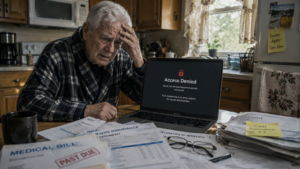
Many older adults today are dealing with physical and/or mental challenges such as poor eyesight, memory loss, lack of cognitive functioning, and loss of fine motor skills. This makes them extremely vulnerable to cybercrime including falling prey to scams, phishing emails and even fake phone calls claiming to be from technical support departments of banks, credit card companies, etc.
That is Techno Babble.
The Real Problem with Techno Babble
The problem is not technology itself.
The problem with Techno Babble is that people have started to assume that everyone should be able to use new technology.
That assumption is flawed.
There are many older adults in this country who are not users of broadband, smartphones and other digital tools. They are less likely to become users of these technologies than their younger counterparts. Many millions of Americans do not have access to broadband at home and need more digital literacy training to fully participate in our increasingly digital world.
Access alone is not enough.
And the ability to safely and efficiently use those services is just as important.
However, businesses continue pushing harder toward automation:
- AI customer support
- Cashless transactions
- Self-service portals
- Paperless billing
- Automated phone systems
And here is my concern.
We are accepting this as “just the way things are.”
I disagree.
Technology should support people. Not replace them.
Digital Exclusion Is a Leadership Problem

This is where leadership enters the conversation.
Prepared leaders ask better questions.
- What happens when the internet goes down?
- What happens during a cyberattack?
- What happens when the over 70 customer cannot navigate your portal?
- What happens when a parent without broadband cannot access critical school alerts?
These are not technology problems.
These are continuity problems.
I have found a great way to examine the ability of a system to handle a disruption by looking at the system through the lens of a business using the preparedness materials from Resilient Leadership. The system as a whole must continue to operate during a time of crisis or disruption.
A system of people supported by technology is going to be much more resilient that a system of technology supported by people.
It is fragile.
And fragility hides in convenience.
Why Techno Babble Creates Hidden Risk
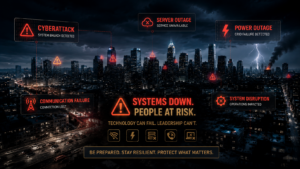
Techno Babble creates the illusion of efficiency while increasing hidden vulnerabilities.
For example, if:
- your bank eliminates human tellers,
- your hospital forces app-based scheduling, or
- your emergency plan is only executed using digital communication methods.
Then one outage can trigger immediate failure.
Convenience Creates Fragility
According to Cybersecurity and Infrastructure Security Agency (CISA), operational disruptions caused by cyber incidents continue to affect organizations and businesses. In Ready.gov Business Continuity Planning, Alternate Methods of Communication and Continuing Operations are recommended when a system fails.
Notice the theme.
Redundancy matters.
Human systems matter.
Backup plans matter.
My Book: Why Plans Don’t Prepare You

The implications of a disaster for techno babble-loving companies to operate from a prepared plan, or even a pre-loaded “business continuity plan” from a contractor is exposed in great detail in the rest of My Book: Why Plans Don’t Prepare You for a Disaster.
One of the core messages in the book is simple:
When disruption comes, people do not follow binders. They follow leadership.
I would add something else here.
People Do Not Follow Apps
When systems fail, people follow calm and competent leadership.
They look for someone who can communicate clearly, adapt quickly, and keep operations moving.
Even the most sophisticated digital workflow, packed with apps and online portals, becomes useless when technology fails and people are unprepared to lead through the disruption.
Real readiness asks:
- Can we still function manually?
- Can we communicate without apps?
- Can we serve vulnerable populations?
- Can we continue operations under stress?
Those are leadership questions.
Leadership not software will be able to protect people in a given situation in a change of conditions.
Final Thoughts on Techno Babble
I am not anti-technology.
I use technology every day.
But I am against blind dependence.
The ease of ‘convenience’ of technology and its use on a daily basis can blind us to the risks associated with it.
The underprivileged are being excluded.
Older people are being isolated.
Organizations are becoming more fragile.
And society is quietly accepting it.
We need to stop assuming digital equals better.
Sometimes progress is not progress.
Sometimes resilience means keeping the human option alive.
That is not old-fashioned.
That is preparedness.
Preparedness Is Leadership
Additional Information: Implications Of The World Economic Forums Declaration
Till next time
Stay Informed & Stay Safe
Daniel Kilburn
Founder · Emergency Action Planning
📘 For more information go to: whatstheplandan.com/book

Postscript
The next major disaster may not begin with a hurricane, wildfire or earthquake. It may begin with a server outage, cyberattack, AI failure, a telecoms blackout or a wide spread grid failure
The next major disaster may not be a natural disaster brought on by a hurricane, wildfire or earthquake, but could be caused by a failure of a server, a cyber attack, the failure of an AI system, the failure of a telecoms system or a massive failure of the power grid.
That is a human-made disaster.
Disruptions to technology systems also happen at the worst possible time.
In Why Plans Don’t Prepare You I go into detail as to why a written plan alone is not enough to prepare anyone for an unknown future and that true readiness comes from great leadership, a very adaptable team, solid communication and plenty of practice at executing a plan under stress.
The real issue is not where is the app when the system has gone down?
The question will be:
Who knows what to do now?
This article was developed with the assistance of artificial intelligence and reviewed, edited, fact-checked, and approved by Daniel Kilburn. All opinions, conclusions, and recommendations reflect the author’s professional experience and judgment.