
The Earliest Sign Your Company Isn’t Prepared for Disruption (And What To Do About It)
The Hidden Risk Most Leaders Miss
Most leaders believe disruption preparedness is about plans, tools, or budgets. But in reality, the earliest warning sign is far more subtle, and far more dangerous.

It’s assumption.
When leadership assumes “everyone knows what to do,” organizations quietly drift into vulnerability. This post will help you identify that early signal and take decisive action to strengthen your business continuity preparedness before disruption tests your team.
The Most Overlooked Early Warning Sign
“We’ve Already Talked About That”
This phrase shows up often in organizations that feel prepared, but aren’t.
“We’ve talked about that.”
“Everyone knows their role.”
“We’ll figure it out.”
At first glance, it sounds like confidence. In practice, it often reveals gaps:
- No documented continuity plan
- Undefined roles and responsibilities
- Unstructured communication protocols
- No real-world testing or drills
These gaps don’t show up during calm—they show up during chaos.
What Happens When Assumptions Meet Reality
When disruption hits, assumptions collapse quickly.
- Direction is given → but interpreted differently
- Communication begins → but lacks structure
- Teams act → but not in alignment
This isn’t a failure of effort. It’s a failure of coordination.
According to Ready.gov, organizations with tested continuity plans recover faster and reduce operational downtime significantly. The difference isn’t resources, it’s clarity.
What Prepared Organizations Do Differently

They Replace Assumptions with Clarity
Organizations with strong organizational resilience can answer three critical questions instantly:
- Who makes decisions in the first 15 minutes?
- How do we communicate if systems fail?
- What operations must continue no matter what?
If those answers aren’t simple, shared, and practiced, readiness isn’t real.
They Practice, Not Just Plan
Preparedness is not theoretical.
It’s operational.
It’s what your team can execute under pressure, not what’s written in a document.
For deeper insight, see our related guide:
👉 Building Business Resilience
Why This Matters for Leadership and HR

This is where leadership credibility is tested.
In a crisis:
- Confidence is either reinforced—or lost
- Trust is either built—or broken
- Teams either align—or fracture
For HR and executive teams, crisis management planning isn’t just operational, it’s cultural.
Preparedness signals leadership.
Preparedness Is Proven Under Pressure
If you’ve ever heard, “we’ve talked about that,” you already know where to look.
Start with one simple question:
What would your team actually do in the first 15 minutes?
Because preparedness isn’t what’s been discussed…
It’s what can be executed.
Call to Action
This is where leadership becomes measurable.
👉 Learn where your organization truly stands: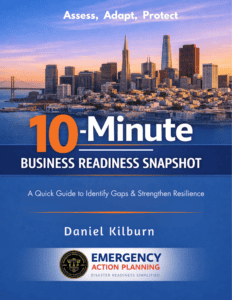
www.eapready.com/business
Till next time
Stay Informed and Stay Safe

Daniel Kilburn
Americas 5-Star Leadership Coach
P.S.
Because preparedness is never one-size-fits-all, other snapshot options are available for families and schools.
If you’re looking to strengthen readiness at home or in schools:
- Family Snapshot: www.eapready.com/family
- School Snapshot: www.eapready.com/school