
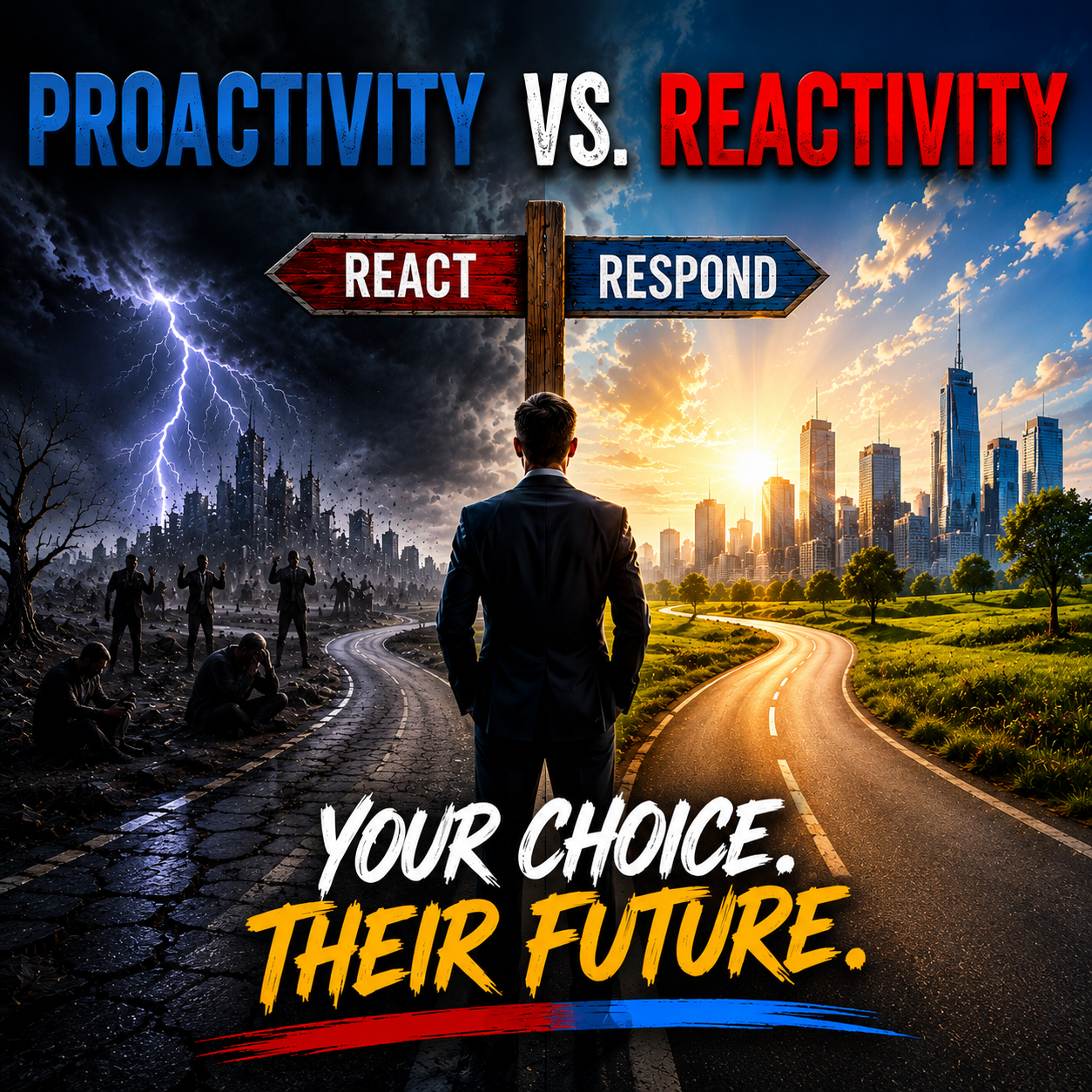
Proactivity vs. Reactivity: The Leadership Difference That Determines Outcomes
It happens to the best of leaders. At the most inopportune moment, stress surfaces and, even before you know what is happening, you have reacted in a way that you later regret. This phenomenon is so common that it is almost a expected.
But what causes it? More importantly, how can leaders move from being reactive to proactive in their leadership?
Recently I read a great publication from Resilient Leadership LLC titled Understanding Reactivity. This publication outlined how high levels of anxiety cause individuals and organizations to behave in certain predictable ways, in a state of reactive and emotional behavior as opposed to calm thoughtful behavior.
This document outlined the predictable patterns of conflict, distancing, over-functioning, under-functioning and even triangulation that exist within individuals and organizations under stress and operating in a reactive state.
You see these same patterns in organizations, in your neighborhood, schools, families and even in our government.
The question is simple:
Lead proactively, or wait until pressure forces you to react.
Prefer to watch or listen? Here’s a brief video introduction to this article.
Why Reactive Leadership Creates Vulnerability
Reactive leadership rarely begins with bad intentions.
The first thing to remember is that leaders don’t necessarily start out trying to be bad for their organization. Typically, they intend to do good by them. However, as uncertainty increases so do emotions, and emotions typically get the best of people, especially when they are anxious. This results in a cycle of increased feelings that lead to a series of steps that are taken in an increasingly reactive manner. As a leader becomes increasingly anxious, they are more likely to take actions that are reactive rather than thoughtful, often resulting in decisions that are not in the best interest of the organization.
In a state of elevated anxiety, an individual will continue to exhibit more and more reactive behaviors until the entire organization is caught up in a cycle of thoughtless leadership.
These states can create a cycle where higher levels of anxiety cause more and more reactive behaviors.
As a result, leaders may:
- Focus on symptoms instead of causes
- Rush decisions without sufficient information
- Over-control people and processes
- Avoid difficult conversations
- Blame individuals rather than address systems
- Be completely absorbed in solving the current problems and therefore not look for potential problems in the future.
You can be in trouble even before things go wrong.
Proactive Leadership Builds Readiness Before Pressure Arrives
Unlike Resilient Leadership, Proactive Leadership focuses on the leadership’s preparation to handle situations before emotions start to play a role.
Good leaders expect things to go wrong; emergencies, cyber-attacks, staff shortages, financial problems and operational failures. These are not issues of if they will happen but rather a case of when.
A great leader creates systems to make good decisions even when things go badly.
Proactive leaders:
- Identify vulnerabilities early
- Establish communication systems
- Clarify decision authority
- Train key personnel
- Build resilience into operations
- Test assumptions before they are tested by reality.
Most importantly, they create confidence through preparation.
By developing organizational continuity before it is needed, leaders create an environment where disruption does not automatically produce confusion or panic. Teams remain focused, communication stays intact, and leaders are able to make thoughtful decisions that protect the mission, the people, and the organization.
Leadership Readiness Reduces Fear
Fear often thrives in uncertainty.
Most fears are born out of uncertainty and so in times of crisis when things are not clear. i.e. who is in charge and how decisions will be made, then there is bound to be anxiety in the air. But a good leader such as one practicing Resilient Leadership will remain calm and still be able to think clearly of the way forward when all others are struggling to cope. The leader does not appear to be affected by the growing pressure and others too will remain calm. The leader appears to have a sense of direction even when all seems lost and is able to make the best decisions and lead others in the organization through the crisis.
That concept is at the heart of leadership readiness.
The purpose of preparedness is not to eliminate fear.
The purpose is to reduce uncertainty.
- When uncertainty decreases, confidence increases.
- When confidence increases, decision quality improves.
- When decision quality improves, organizations become more resilient.
Prepared leaders do not wait for certainty. They build readiness, take action, and adapt when the unexpected occurs.
— Daniel Kilburn
Preparedness Is Leadership.
How Why Plans Don’t Prepare You Solves This Problem
Most organizations think having a written plan is enough to prepare them for anything that comes their way.
Preparedness and planning are not the same thing.
In the introduction to Why Plans Don’t Prepare You, I explain why organizations often mistake having a plan for being prepared.

- A plan in a binder does very little during a crisis.
- A binder cannot think.
- A document cannot communicate.
- A checklist cannot inspire confidence.
Leadership can.
The book addresses four common fears that often drive reactive leadership.n
Fear of Making the Wrong Decision
Fear of making the wrong decision often causes leaders to delay action or react emotionally under pressure. Yet disruption rarely provides complete information or perfect clarity.
Why Plans Don’t Prepare You teaches leaders how to make sound decisions in uncertain environments by relying on preparation, critical thinking, communication, and adaptability. The goal is not perfection. The goal is confidence, action, and the ability to adjust as new information becomes available.
Fear of Being Unprepared
Many leaders fail to start building their readiness for leadership because they think it is too complicated to begin with and put it off to a later time.
But readiness can be step by step.
Small steps, consistently performed, create a great deal of resilience.
Fear of Losing Control
Reactive leaders often attempt to control everything.
Reactive leaders often believe preparedness comes from controlling every detail. Prepared leaders understand that resilience is built through leadership, communication, training, and systems. As a result, when disruption occurs, the organization can adapt, continue operating, and accomplish its mission despite changing conditions.
Fear When the Plan Fails
Every plan eventually encounters unexpected circumstances.
That is why resilience matters more than documentation.
Organizations that can adapt, communicate, and continue operating through disruption will consistently outperform those that depend solely on written plans. Plans are important, but they were never intended to address every unexpected challenge a leader may face.
Strategic Readiness Creates Resilient Leadership
One of the principles emphasized by Resilient Leadership is the importance of becoming an observer of your own anxiety rather than a participant in it. Leaders who can recognize their emotional responses without being controlled by them are better positioned to maintain perspective and make sound decisions during periods of uncertainty.
Strategic readiness is what enables calm leaders who are not afraid because they are not surprised by events. They are not fearless. They are simply less surprised because they have invested in their preparation beforehand.
Prepared leaders are not fearless.
They are simply less surprised.
Prepared leaders invest in readiness before it is needed. Therefore, when challenges arise, they can respond thoughtfully rather than react emotionally.
That is the true advantage of proactive leadership.
Final Thoughts
Disruption will occur in every organization, every family and every community. The real question is whether the leadership is prepared for the inevitable crisis.
The difference is not whether disruption arrives.
The difference is whether or not the leader of that organization has prepared themselves and their teams for that disruption.
Reactive leadership waits for the problem.
Proactive leadership prepares for it.
One increases anxiety.
The other builds resilience.
The choice ultimately belongs to the leader.
Additional Leadership & Preparedness Resources
The following resources provide additional insight into leadership under pressure, organizational resilience, preparedness, and decision-making during times of uncertainty. Together, they reinforce the importance of proactive leadership and readiness before disruption occurs.
Resilient Leadership LLC – Understanding Reactivity
Resilient Leadership Development
Federal Emergency Management Agency (FEMA) – Preparedness Resources
Ready.gov Preparedness Resources
Ready.gov – Business Preparedness Resources
Ready.gov Business Preparedness Toolkit
Harvard Business Review – Crisis Management & Leadership
Harvard Business Review Crisis Management Collection
National Institute of Standards and Technology (NIST) – Risk Management Framework
NIST Risk Management Framework
Preparedness Is leadership
Till next time
Stay Informed & Stay Safe

Daniel Kilburn
Founder · Emergency Action Planning
P.S.
One of the biggest problems facing companies today is not that of a hacker breaking into your computer system, a hurricane or a power outage?
It is reactive leadership.
And while a company is in a state of fear, uncertainty and anxiety to make decisions the worst disruptions of all are created. Communication breaks down, the leader is overwhelmed, the team loses trust and motivation and crucial decisions are taken too late, even emotionally.
Why Plans Don’t Prepare You was written to address the issue of reactive leadership in today’s companies.
The way most organizations try to get ready for future problems yet to come is to develop more elaborate plans and to stock up on more detailed planning binders. But the book Why Plans Don’t Prepare You for Future Disruption shows that this is not where preparedness comes from. Instead, it comes from leaders who can think straight in a straight crisis, communicate with others, and bounce back from shock and stress as uncertainty unfolds.
People will not follow a plan in a crisis. They will follow a leader.
📘 Order Why Plans Don’t Prepare You on Amazon:
This article was developed with the assistance of artificial intelligence and reviewed, edited, fact-checked, and approved by Daniel Kilburn. All opinions, conclusions, and recommendations reflect the author’s professional experience and judgment.